


Suzanne Johnson, Whanganui-a-Tara
Meeting with colleagues appealed to me after several years of avoiding large gatherings, as did the timely conference theme. I hoped that sexuality and gender, often unspoken, argued, evocative, might be opened up, allowed. I was looking forward to the theme, ‘Sex, society, and the self: Navigating the shoals’ as an invitation to open discussion and an opportunity to find our way with seemingly new (though, in reality, probably not new) sexualities and identities. This invitation felt like a relief, and a potential space to be more ‘self’, more present.
I experienced the large group as warmly and cautiously held by the organising committee, after tangata whenua welcomed us with powhiri that was powerful and stirring—affirming the place, and relationship of tangata whenua and tangata Tiriti. Opening kōrero was, with Waka Oranga and Kaumatua Haare, and the organising committee, sacred and political—acknowledging our place on the earth, under the sky, in relationship with each other, and the ongoing mahi and the willingness this takes. Haare and Verity described some of their journey from Auckland, on the bus, past Māngere fields where British soldiers camped in 1868 on the land where 23 Māori families had been living. Life and destructive death, past and present, in our world.
As happens with powhiri, the space felt opened, between sky and earth, Rangi and Papa – a binary of a kind though more like North and South poles in that if the edges are held, rumblings within the space will not necessarily skew the axis. The hui felt contained and open with a sense of anticipation, that there might be danger if kōrero got too loose or close to the rhetoric of right or wrong identities and sexualities.
Prior to conference, I was appreciating and slowly reading, savouring, two relevant books. One was Gender without identity by Avgi Saketopoulou and Ann Pellegrini (2023). Described on the inside cover as offering “an innovative and at times unsettling theory of gender formation.” Satisfyingly, Gender without identity was referenced by two conference presenters, Phoebe Hunter and John O’Connor. This book offers therapeutic encouragement to “patiently being with the patient”, offering ”patient affirmation” that is “the patient’s right to have their own, non-linear process” (Saketopoulou & Pellegrini, 2023, p. 27) towards their own gendered subjectivity. The authors reference LaPlanche, in that for all of us, the sexual and gendered messages received from infancy are “invasive, and scrambled” (Saketopoulou & Pellegrini, 2023, p. 26), and ego and subjectivity are formed in response to these invasive punctures, including our experience of gender. In my translation, this puts us all on a similar human trajectory – forming a mosaic of gendered and sexual subjectivity, and the sense of an ‘I’ via significant, enigmatic input from others.
Saketopoulou and Pelligrini consider that all genders and sexualities are arrived at with some degree of trauma; that is, the introjections and puncturing from others’ gender and sexual expressions, repressions, actions, etc., toward and around the infant. “As long as the subject is able to modify what was handed down to them intergenerationally, and to forge out of those inheritances their own gender translations, gender is not pathology” (Saketopoulou & Pellegrini, 2023, p. 29). Perhaps everyone has cobbled together both defensive and authentic identity and sexuality? I like to consider that we may be more diverse than assumed, perhaps in fantasy if not in action. Danielle Knafo and Rocco Lo Bosco (2020) describe sexual diversity in their informative and contemporary book, The new sexual landscape. The front cover flap states:
The sexual landscape has changed dramatically in the past few decades, with
the meaning of gender and sexuality now being parsed within the realms of
gender fluidity, non heteronormative sexuality, BDSM, and polyamory. The sea
change in sexual attitudes has also made room for the main streaming of
internet pornography and the use of virtual reality for sexual pleasure – and
the tech gurus have not even scratched the surface when it comes to mining
the possibilities of alternative realities.
The authors describe a range of human sexual and gender expression that is out and about in our social world and, increasingly, in our therapy rooms. It briefly describes various sexual practices and fantasies, and their potential pscyhic origins. The authors’ nonjudgemental style made diverse human sexual expression seem more ordinary and knowable. Reading this book, the perverse might be understood more in terms of what is injurious to self or other (e.g., violent pornography and exploitative abuse) rather than who or what one fancies or how we create or change our gender. While reading this book, written with an easy, observational style, I noticed I could breathe more freely. Reading both books simultaneously, with their descriptions of the complexity of all gender formation and diversity of sexual expression, evoked for me a sense of a broader identity and sexual space to inhabit, both containing and expansive. A good preparation for this hui.
A day or two into conference, several new, young members bravely introduced themselves as non-binary or transgender. A few others introduced themselves as lesbian, gay, bisexual. Gender and sexual orientation was always in the room, and woven into personal, clinical, and cultural stories by the presenters and the panel “Indigenous and Tagata Moana persepectives on gender and sexuality’. Presenters spoke of their sexuality and identities as gay, lesbian, straight; and evoked thoughts of my own adolescent sexual and gendered learnings. While I enjoyed the sexual revolution of the 1970s, when sexuality was often considered beautiful and liberated, sexuality and gender were also denigrated and exploited, as they still often are. Light and dark. Sometimes binary, sometimes complex.
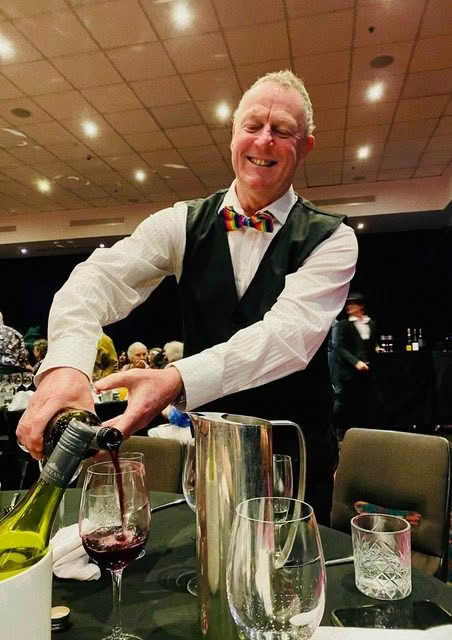
I enjoyed the conference dinner and my 15 minutes of dancing to upbeat jazz. It felt as if the body and sexuality were politely allowed out at this conference. I imagine there were myriad reactions to all that was spoken and not spoken, seen and not seen. To be continued, I hope, toward opening up to self and difference, and to not knowing. As Haare said “getting to know people is an act of respect and reverance”. My sense was this conference invited us to put a toe in the water of emerging gender and sexual diversity, while not yet diving into the sea (Virtue, 2024).
References
Knafo, D., & Lo Bosco, R. (2020). The new sexual landscape and contemporary pscyhoanalysis. Confer Books.
Saketopoulou, A., & Pellegrini, A. (2023). Gender without identity. The Unconscious in Translation Press.
Virtue, C. (2024, May). Being and becoming: Crossing the divide. [Paper presentation]. NZAP 2024 conference, Rotorua, Aotearoa New Zealand
0 Comments